Strong and weak solutions to PDEs

Solving a differential equation is usually tough. Sometimes, impossible. In such cases, one can resort to qualitative and numerical methods to understand something about the nature of the solution. But when the equation encodes relevant physical information, there is further motivation to go beyond numerical explorations and search for analytic solutions. If luck is on your side, the solution resides in a long list of special functions to which many brilliant people have contributed over time (e.g., I can recommend this book). After that, all that remains to be done is to set appropriate initial/boundary conditions and use those to specify coefficients. But most likely one won’t be lucky and will have to work harder. Or weaker, by weakening the concept of differentiation in your differential equation. This is indeed a concept that has proven very robust in the study of differential equations. Take a look at the Wikipedia entry on this topic. While this is an old idea in mathematics, I have not seen many applications in the physical sciences. We are probably neglecting an interesting strategy.

Tight-binding and other powerful toy models

It is interesting how much one can achieve with these models. I have used tight-binding models in the past to understand the electronic structure in simple molecules, as well as to model electronic transport in nanoscale systems. More recently, I have been exploring thermal and mechanical properties in 2D materials within this framework. In order to define a model structure, all you need to find are the energies of the electronic levels and some the magnitude of the hopping terms, the latter representing atomic overlaps and other tunneling mechanisms within the system (See for example https://en.wikipedia.org/wiki/Tight_binding).  As a result, complicated internal interactions (coulomb potential, phonon-electron vibrations, …) are hidden into the level energies and hopping terms. The mapping from the real to the model system is achieved through different techniques (DFT, Hückel, atomic orbital representations …), deciding with properties of the original system are relevant (accessible orbital energies, timescales, …), and, of course, such representations are likely to miss important characteristics from the original system.  But what comes as an advantage with this simplification, is that the rigorous analysis of such models is, to a great extent, possible. When the model is a faithful representation of the real system, one can argue that the simplifications utilized in the definition of the model system, reveal which aspects of the actual system are relevant for the physical questions that one wants to investigate.

Water

An interesting summary, by John Baez, of experimental findings and theoretical conjectures around the hydronium chemical structure.

John Baez's avatarAzimuth

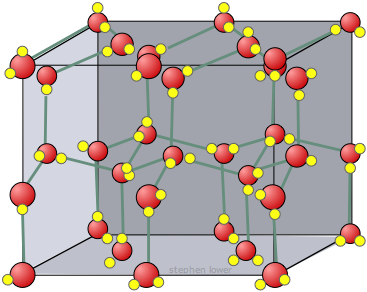
Over a year ago, I wrote here about ice. It has 16 known forms with different crystal geometries. The most common form on Earth, hexagonal ice I, is a surprisingly subtle blend of order and randomness:

Liquid water is even more complicated. It’s mainly a bunch of molecules like this jostling around:


The two hydrogens are tightly attached to the oxygen. But accidents do happen. On average, for every 555 million molecules of water, one is split into a negatively charged OH⁻ and a positively charged H⁺. And this actually matters a lot, in chemistry. It’s the reason we say water has pH 7.

Why? By definition, pH 7 means that for every liter of water, there’s 10-7 moles of H⁺. That’s where the 7 comes from. But there’s 55.5 moles of water in every liter, at least when the water is cold so its density is almost…

View original post 1,503 more words

Interacting systems in the Fock space.

Tags

, , , , , ,

I’m following several books on this topic. I’m highly interested in the formal aspects of QFT, as well as applications to the description of molecular phenomena. The classical book from Gérard Emch titled Algebraic Methods in Statistical Mechanics and Quantum Field theory  has taken much of my attention these days (nights), not only for its clear and detailed presentation of the topic, but also because of its early conclusion: “the Fock-space formalism is actually not sufficient for a general description of interacting fields”. That would certainly leave many interesting physical and chemical phenomena out. I should point out here that this book was published in 1972 and the above statement might have been refrased in more positive forms as the field progressed. The book suggests that problems arise in the form of  improperly defined transformations and infinities.  I expect many these infinities to come from diverging sequences. The author states, as he works on one example,  that the total Hamiltonian for the van Hove model for a field interacting with a point charge loses its meaning as an operator acting on the Fock Space. In that case the Hamiltonian is ill-defined and one should not but be afraid, because of the absence of well-defined operators can only lead to a wrong interpretation of the physical observables. The solution to this potential  catastrophe, at least the one proposed there, residences on a different approach where the algebra of the operators is considered first independent of any particular Hilbert space. I will have to teach and convince myself about these ideas as I travel along this book.

  My first approach to the formal construction and properties of the Fock space as a Grad student was in a seminar intended to teach quantum mechanics to mathematicians, organized by Prof. Leonard Gross in the spring of 2011 at Cornell. In this seminar we went as far as to study free fields such as the electromagnetic field. And there, problems such as the popular

\Sigma_{n=0}^{\infty} \frac{1}{2}

— that appears in many physics books in the quantization of the electromagnetic field — were  solvable within the Fock space.  Other topics were discussed as well, but they mostly served as a preparation for this topic. Here you have Prof. Gross’ lecture notes if you want to know more.  This seminar took place a year after a special graduate course imparted by Prof. Garnett Chan about electronic structure in the Chemistry department,  which included one modulus devoted to introduce several many-body techniques — such as green functions, Feymann diagrams, Wicks theorem and the Dyson equation and others– as they apply to quantum chemistry.  Based on what I learned and judging by the great amount of literature that shows how effective these techniques are in the study of interacting systems, I find hard to understand how these two situations — the one described in the book mentioned above and the great success in the description of many real systems — can occur simultaneously. This apparent ambiguity is very common between science and math. It was always present while I was educated as a scientist.

I’m about to start reading the second part of the first chapter of Emch’s book, where the alternative and more algebraic approach to the description of systems with infinite degrees of freedom is introduced. I believe that what I’m about to learn is something well established among the experts. Certainly,  I will enjoy and benefit from this reading.  Alongside, I keep another great book: Quantum theory of Many-Particle Systems by Fetter and and Walecka. My hope is that together they will provide a good balance between the formal aspects and physical motivations. I’m planning on posting from what I learn as I progress on my reading.

Create your own website, free on WordPress.com.Create your own website.
Start free